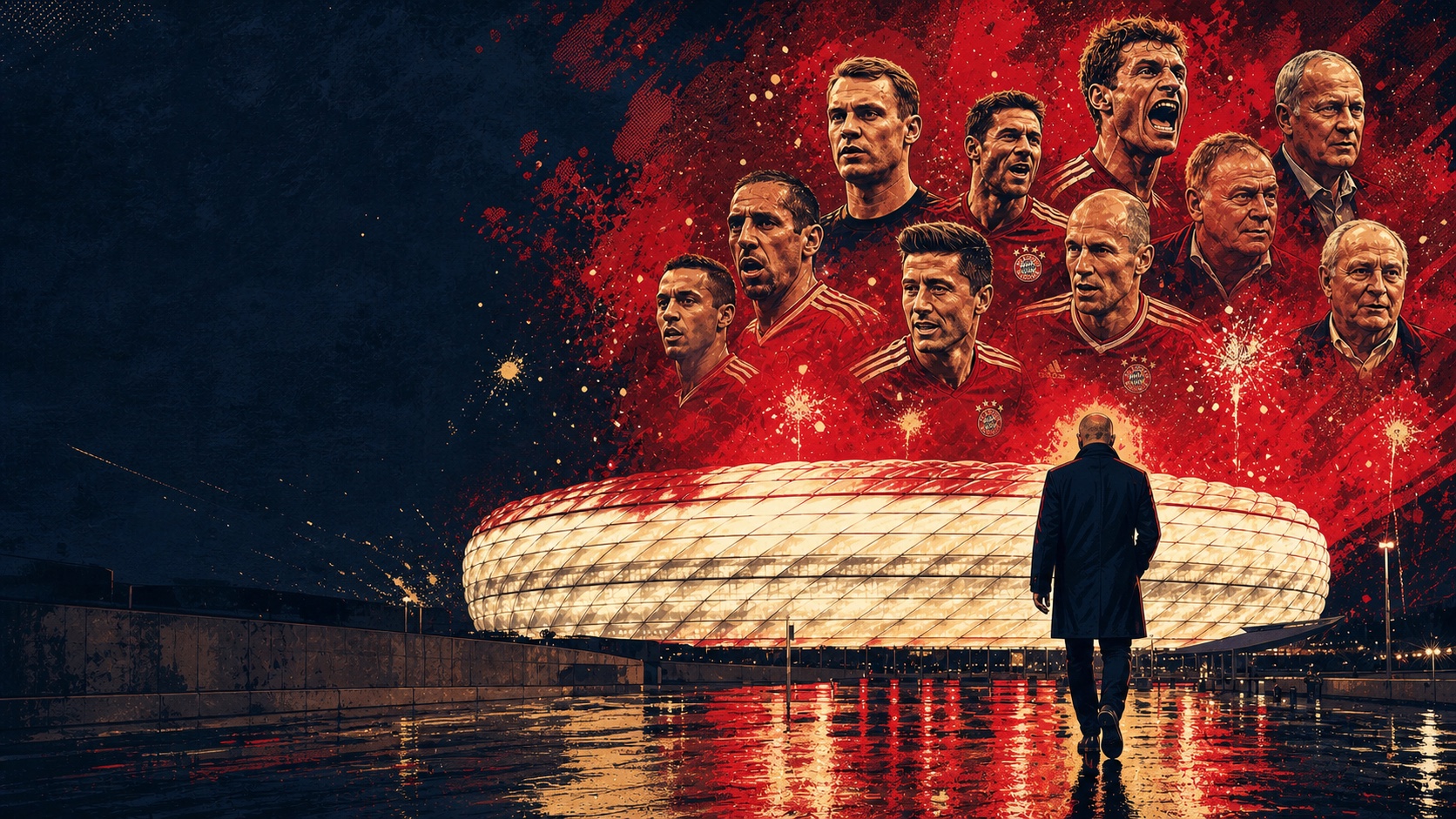
Historical analysis · Bayern Munich
Pep’s Purest Reign
Guardiola’s best spell was not Barcelona or Manchester. It was three restless, record-breaking years in Munich.
The stills most closely associated with Pep Guardiola come from Barcelona and Manchester City: lifting the European Cup at Wembley or sitting on the pitch in Istanbul after completing the treble. His three years at Bayern Munich didn’t produce any such snapshot in your head, and that missing image has become the prosecution’s favourite thing to moan about. That is why the period matters: Guardiola was bequeathed a treble-winning side, then tested how far he could alter it without the familiarity of Barcelona or the sovereign wealth he later had at City.
There was no rebuild to hide behind and no glaring deficiencies requiring surgery. Jupp Heynckes had just produced the first treble in German football history; Guardiola was being asked to renovate the palace without disturbing the royal incumbents. He had to retain the ferocity of Europe’s best team while persuading accomplished players to learn his fountain of knowledge by taking on unfamiliar roles. Any change could be wrongly dismissed as vanity.
Changing the Weather
Transitions invaded German football in 2013. Jürgen Klopp’s Borussia Dortmund pressed with evangelical zeal, and Bayern had just mastered Europe through brawn, width and velocity. Guardiola lived by those qualities, then restructured the team around possession. Full-backs moved into midfield, Philipp Lahm transformed into a No.6, centre-backs carried the ball up the pitch, wingers swapped sides, and Manuel Neuer defended in postcodes rarely frequented by goalkeepers.
Neuer, the centre-backs and the pivot establish the first platform for possession.
The effect travelled beyond Säbener Straße, Bayern’s training complex. “This idea is apparently new to German football,” sporting director Matthias Sammer said while defending Guardiola’s frequent system changes. Half-spaces, inverted full-backs and positional play entered the weekly Bundesliga lexicon. Some opponents lent parts of the approach; others deformed their shape specifically to resist it. Imitation and resistance (a familiar pattern in Guardiola’s coaching career) were not in short supply.
Bayern also changed the cadence of matches. Five players could colonise the opposition’s last line, allowing the team to suffocate a counterattack almost before it had drawn its first breath. Arjen Robben and Franck Ribéry still dribbled and bombarded the goal, but they were also accountable for holding the width while teammates plugged the centre. Guardiola wanted them to decide when to fire the starting gun.
We are happy, fortunate and grateful to have a coach like Pep Guardiola.
Matthias Sammer, 2014
Bayern’s directors' support was significant. The club’s hierarchy is known for destabilising its coaches rather than supporting them steadfastly. Yet Karl-Heinz Rummenigge said Guardiola could remain indefinitely and described the proposed renewal as very attractive. Bayern were also prepared to pay top dollar in the coaching market. Sammer, initially viewed as an internal counterweight, became one of Guardiola’s strongest advocates.
Views of Guardiola deviated during his three years. He arrived amid scepticism that he would import sluggish, lateral possession into a league built on sheer speed. By his final season, the arguments concerned his vehemence, his deteriorating relationship with the medical department and the Champions League rather than whether his football had any substance. Controlled possession had become part of Bayern’s modus operandi.
The Numerical Peak
Bayern won 82 of Guardiola’s 102 Bundesliga matches: an 80.4 per cent win rate, 257 points, 254 goals and only 58 conceded. Across the equivalent first three league seasons, his Barcelona won 88 of 114 matches and Manchester City won 87 of 114. Bayern won more frequently, conceded fewer goals and averaged 2.52 points per game. The missing European Cup dominates the conversation; domestically, Munich was Guardiola’s numerical high-water mark.
Data from the final season shows how that dominance was produced. Across all 34 Bundesliga matches, Bayern averaged 2.16 expected goals and allowed 0.66. They completed more than four-fifths of all final-third passes in their matches and restricted opponents to 7.5 shots per game. Sustained territorial control, rather than finishing alone, supported the results.
Bayern 2015/16 · verified data
A Season of Total Control
34 matches · per 90 where statedTerritorial Control
82.4%final-third completed-pass shareFour more indicators of control
The transformation did not call for a convoy of armoured trucks via the transfer market. Bayern’s three-year net spend was roughly €83.5 million, less than Barcelona’s across Guardiola’s four seasons and a pinch of City’s early rebuild. Robert Lewandowski arrived on a free transfer, while Xabi Alonso, Juan Bernat and Thiago plugged specific holes; Joshua Kimmich cost around €8.5 million. Much of the improvement came from asking big-name players to retrain and realise another role.
Bayern were wealthy and held significant structural advantages over their domestic rivals, but Guardiola did not rebuild the starting XI each summer. Jérôme Boateng became an important long-range passer, David Alaba moved between defence and midfield and Thomas Müller continued to interpret space within several different structures. The squad became more versatile without becoming more expensive.
The aim is to extend Guardiola’s contract.
Karl-Heinz Rummenigge, 2015
The Missing Cup
The Champions League remains the spearhead against Guardiola’s tenure, but hashing together the three semi-final defeats is lazy work. Against Real Madrid in 2014, Bayern lost the second leg 4–0 after adopting a more direct and attacking plan supported by senior players. Lahm later confirmed that the players helped choose the approach, while Guardiola accepted accountability. It was a disastrous tactical decision on one night only.
A year later, Bayern faced Barcelona without Robben, Ribéry and Alaba. They kept the eventual treble winners scoreless for 77 minutes at Camp Nou before Messi, Suárez and Neymar turned the tie into a kickabout in their back garden. In 2016, Atlético survived through Jan Oblak’s stonewalling, an away goal and Thomas Müller’s missed penalty. Bayern won the second leg 2–1 and departed on the now defunct away goals rule. All three defeats overshadowed the brilliance of Guardiola’s domestic work over the course of his spell.
A Strong Base
Guardiola’s first season also preceded Germany’s 2014 World Cup victory. He did not create Joachim Löw’s champions, whose development began well before his arrival, but his work at Bayern supported their belief in carrying out fluid roles. Seven Bayern players appeared in the final: Neuer, Lahm, Boateng, Schweinsteiger, Kroos, Müller and match-winner Götze. Lahm had spent much of the season in midfield, Neuer regularly swept behind an ultra-high line, and Boateng and Kroos had played through pressure every week.
The influence also ran in the other direction. Guardiola inherited players developed through Germany’s post-2000 academy reforms and Löw’s increasingly technical national team. Bayern then gave those players a demanding daily environment in which to extend that education. The World Cup victory cannot be credited to one club coach, but Bayern supplied much of the team’s tactical core and experience. Götze’s winning goal was a neat connection between the two projects without belonging exclusively to either.
Views in Germany remained divisive because Bayern’s seasons are ultimately defined by their European exploits/failures. Guardiola’s best team was neither Barcelona disguised in red nor a rich bully crushing flimsy domestic opposition. It amalgamated Juego de Posición with Bayern’s physical force and Germany’s counter-pressing tradition, regularly changing shape within minutes.
Barcelona was Guardiola’s home and Manchester City became his domicile of choice. Bayern has been categorised as the forgotten odyssey: he arrived immediately after a treble, spent parsimoniously and changed the zeitgeist within German football. He did not win the Champions League in Munich, and that blot on his copybook will always stalk him as Ted Bundy did to his victims. However, he became the first coach to lead Bayern to the four-peat (four league titles in a row), with some help from Heynckes in the first; the legendary side of Franz Beckenbauer and Gerd Müller in the 1970s could not match that.
Continue reading
The Next Idea
Why De Zerbi Is the Next Bielsa
Two restless idealists joined by conviction.
Read the essay →