Tactical essay
Why Roberto De Zerbi Is the Next Marcelo Bielsa
Two restless idealists, separated by a generation and joined by conviction.
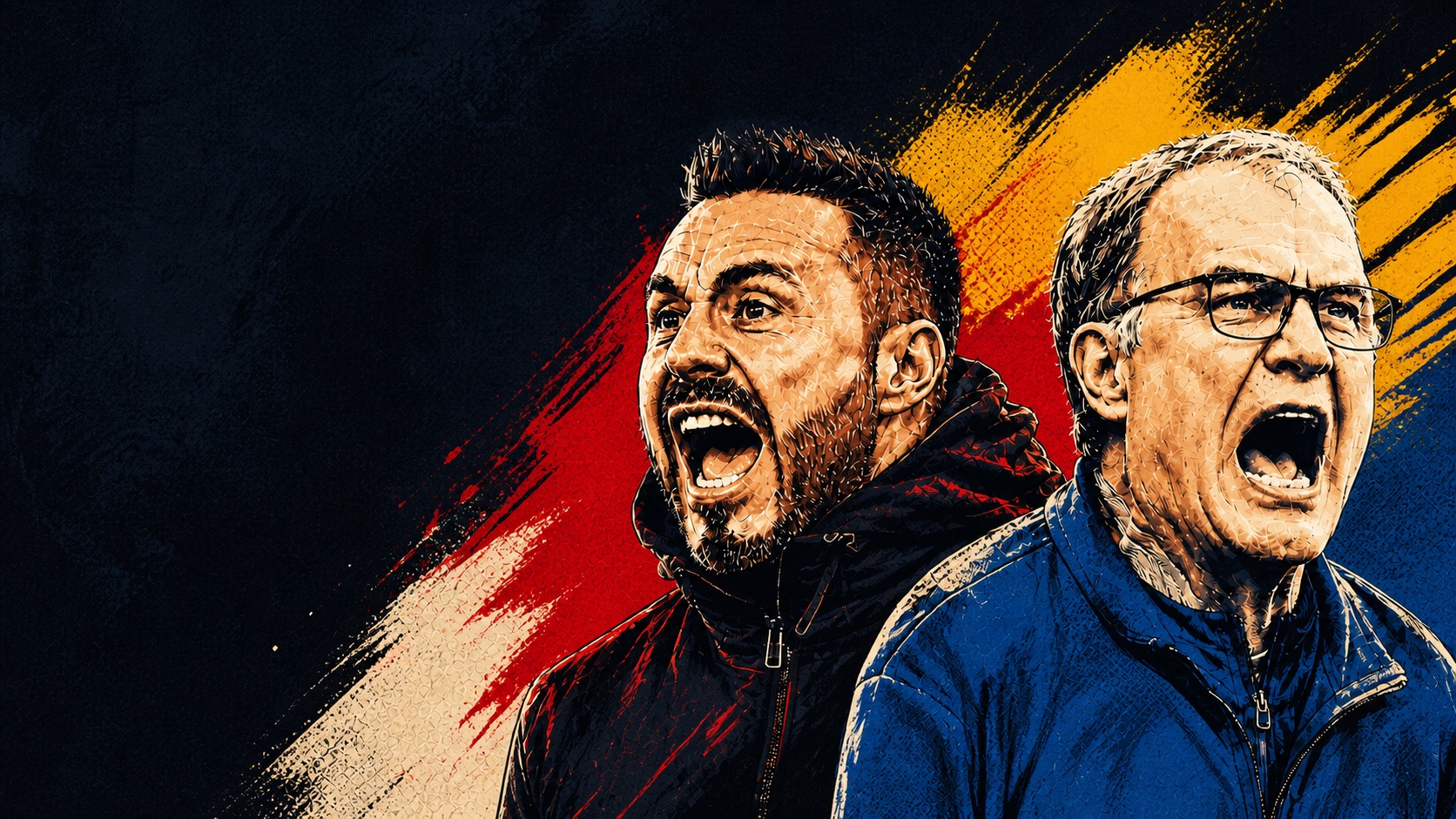
Roberto De Zerbi’s comeback at Tottenham feels like another sequel in football’s long romance with the headstrong idealist. The comparison with Marcelo Bielsa is not about tracing formations on translucent paper or replicating training drills. Instead, it rests on a common belief: Bielsa built teams around intensity; De Zerbi around provocation and baiting. Both would sooner argue with the evidence than hide behind a low block. Risk is not an occupational hazard but part of the theology, and defeat usually demands better execution rather than a handbrake pull.
The Uncompromising Idealists
Marseille, football’s maelstrom, is the place to begin. Bielsa’s 2014/15 side galloped to the top of Ligue 1 by Christmas before limping to fourth, and he quit after the opening game of the following season. De Zerbi guided OM to second in 2024/25 and back into the upper echelons of the Champions League, but left under a cloud the following February. In both cases, neither stayed long enough to build a dynasty; both left fingerprints everywhere. Marseille welcomed their ideas and amplified their personalities before helping press the detonator.
Bielsa’s Marseille attacked through width, rotations and zealous forward running. De Zerbi’s team was more patient at the base, dangling the ball before opponents and then fleeing through the spaces their pressure created. Yet different mechanisms produced a scarily familiar emotional arc: immediate conversion, a city dazzled by the blueprint, and conflict once results and relationships soured. Marseille did not simply employ either man; it put every strength and flaw under a microscope.
On Marcelo BielsaI think he’s probably the person I admire the most in world football as a manager and as a person.
Pep Guardiola on Bielsa
Guardiola’s admiration has little to do with their trophy cabinets. Bielsa won domestic titles in Argentina, an Olympic gold and the EFL Championship; De Zerbi’s only senior managerial trophy remains Shakhtar’s Ukrainian Super Cup. Guardiola owns enough silverware to require an extension, yet he studies coaches who change how a team can play. That is where their influence lives: in how they alter other managers' thinking.
In 2006, Guardiola spent 11 hours at Bielsa’s house discussing space, pressing and coaching. Later, De Zerbi presented him with a different conundrum: how could a team create a counterattack while apparently doing nothing, standing over the ball until an opponent lost patience?
Bielsa · win it back
- Lock on man-to-man
- Swarm the receiver
- Attack immediately
De Zerbi · draw them out
- Pause on the ball
- Invite the pressure
- Break the first line
Bielsa locks on to an opponent; De Zerbi pauses until one commits.
Bielsa’s Leeds
9.3PPDA · league-low, 2020/21 season740tackles across the 2020/21 league seasonDe Zerbi’s Brighton
10.2PPDA · second in the league, 2022/23 season67shot-ending high turnovers · league-high, 2022/23On Roberto De ZerbiRoberto De Zerbi is one of the most influential managers in the last 20 years.
Pep Guardiola on De Zerbi
Crossing the Border
Their most acclaimed club work came in England. Bielsa ended Leeds’ 16-year Premier League exile, then finished ninth with 59 points, the best promoted-team total for two decades. De Zerbi carried Brighton to a club-record sixth place, 62 points and European football for the first time. Only three points separated the breakthrough seasons, and both men took clubs used to looking over their shoulders and taught them to reach for the stars.
The league table tells only part of the tale. Bielsa transformed Championship players into the core of a fearless Premier League side; Kalvin Phillips, Stuart Dallas and Patrick Bamford emerged as symbols of collective improvement. De Zerbi inherited good foundations from Graham Potter, but made Brighton more avant-garde in possession. Lewis Dunk, Pascal Groß and Jason Steele attempted passes that could make a risk-averse coach reach for the smelling salts. England gave both men attention, resources and opponents equipped to test their limits.
Bielsa’s Leeds led the league for distance covered and sprints. De Zerbi’s Brighton became synonymous with ‘La Pausa’, luring opponents forward to create ‘artificial transitions’. One pressed the accelerator through the floor; the other was willing to hold fire. Bielsa’s man-marking influenced other English sides, while versions of De Zerbi’s baiting appeared at Aston Villa, Arsenal and Manchester City. Both approaches were copied and eventually countered, the ultimate compliment. Together, they left their mark on Premier League games even when their names are not mentioned.
Their limits were exposed wholeheartedly. Leeds plummeted in Bielsa’s second Premier League season as injuries revealed the physical tax of man-marking. Brighton dropped from sixth to eleventh after losing their midfield fulcrums Moisés Caicedo and Alexis Mac Allister, the midfielders who made De Zerbi’s risks manageable. Both coaches change shape, but the underlying logic is carved into stone. Remove enough energy or press resistance, and valour begins to resemble footballing harakiri.
The idea that they possess only one way to play is not baseless. Bielsa oscillates between a back four and a back three, while De Zerbi has changed his front line and build-up structure across the globe. Beneath those changes, the principles remain non-negotiable. When players struggle, neither coach reaches for the children’s edition of the playbook; he demands pinpoint execution. That conviction can accelerate development, but an exhausted squad may hear only an instruction to run or think harder on empty legs.
Both have received fewer flowers at home. Bielsa is a deity at Newell’s; however, Argentina still views him through the fractured lens of the shambolic 2002 World Cup. De Zerbi’s magnum opus took place in Brighton rather than his native Italy; distance can be the friendliest critic.
Bielsa’s austere demeanour made him a moral figure at Leeds and in Chile. De Zerbi’s defence of his methods made Brighton appear as though they were challenging football’s status quo. Abroad, their differences became part of the charm. At home, every defeat opened old wounds, and every criticism hit harder.
The Difference
Still, De Zerbi is not Bielsa’s twin. Bielsa wants to dominate the next phase; De Zerbi wants the opponent to open it for him. The younger coach is calmer on the ball, if not always on the touchline.
Temperament distinguishes them, too. Bielsa is serious and utterly consumed by his work; De Zerbi is theatrical, combustible and more willing to wage war in public. At 47, Tottenham’s head coach still has time to prove that conviction and the process of adaptation can go hand in hand. To become the next Bielsa in influence, he may have to avoid becoming him in fate.
Continue reading
The Next Idea
Zdeněk Zeman’s Coup de Grâce
Twenty-three league games. Ninety-one goals at either end. One last, doomed bloom of Zemanlandia.
Read the story →